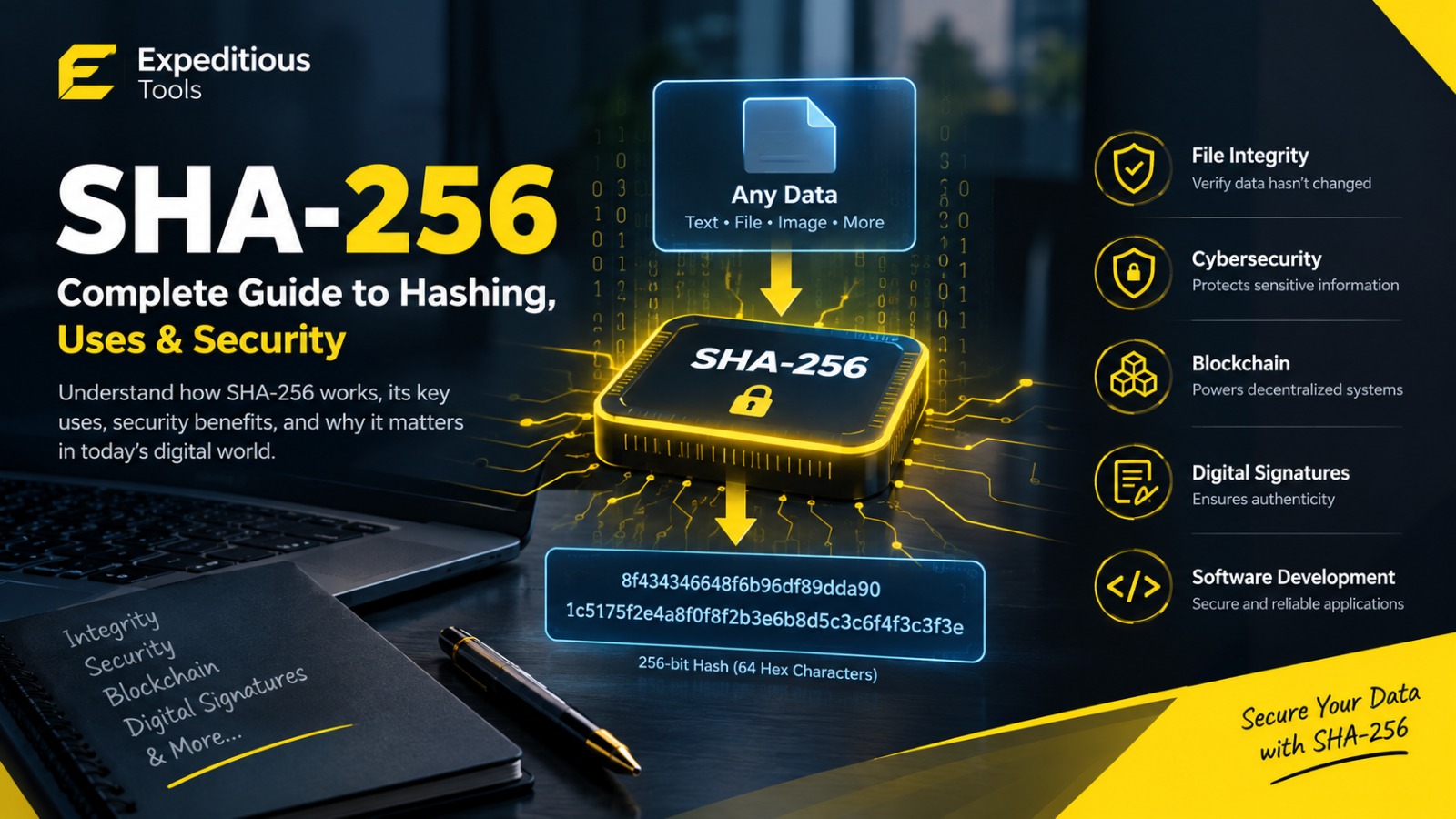
SHA-256 is one of the most widely used cryptographic hash functions in modern computing. It is used in cybersecurity, software development, digital signatures, data integrity verification, blockchain technology, and many other applications where data needs to be represented by a fixed-length digital fingerprint.
If you have ever downloaded a file and checked its SHA-256 checksum, worked with blockchain technology, or encountered cryptographic hashing while developing an application, you have probably come across SHA-256.
But what exactly is SHA-256? How does it work? Is SHA-256 encryption? Can it be decrypted? Is it safe for passwords? This guide explains SHA-256 from the basics to more advanced concepts in clear and practical language.
What Is SHA-256?
SHA-256 stands for Secure Hash Algorithm 256-bit. It is a cryptographic hash function that takes input data of virtually any size and produces a fixed-length output of 256 bits.
The input can be almost anything, including:
- Text
- Numbers
- Files
- Documents
- Images
- Passwords
- Application data
- Digital messages
Regardless of how large the input is, the resulting SHA-256 hash has a fixed size of 256 bits.
When represented using hexadecimal characters, a SHA-256 hash contains 64 hexadecimal characters.
For example, hashing a simple message produces a value that looks like this:
SHA-256 Hash:
8f434346648f6b96df89dda901c5175f2e4a8f0f8f2b3e6b8d5c3c6f4f3c3f3e
The exact output depends entirely on the input.
A tiny change in the input creates a completely different hash.
Is SHA-256 Encryption?
No. SHA-256 is not encryption.
This distinction is important.
Encryption is designed to transform readable information into encrypted data that can later be decrypted using an appropriate key.
Hashing works differently. A cryptographic hash function creates a fixed-length representation of data. It is designed to be computationally impractical to reverse.
For example:
Encryption:
Original Data → Encryption → Encrypted Data → Decryption → Original Data
SHA-256 hashing:
Original Data → SHA-256 → Hash
There is no normal "decrypt SHA-256" operation that returns the original message.
This is why SHA-256 is useful for verifying data integrity and supporting many cryptographic systems.
How Does SHA-256 Work?
SHA-256 belongs to the SHA-2 family of cryptographic hash algorithms. It processes data through a series of mathematical and logical operations to produce a 256-bit result.
At a high level, the process includes several stages.
1. Input Data
The algorithm starts with an input message. This message can be short or extremely large.
For example:
Hello World
or:
A large document containing thousands of words
Both can be processed by SHA-256.
2. Padding
The input is prepared according to the SHA-256 specification. Padding is added so that the message can be processed in blocks of the required size. SHA-256 processes data in 512-bit blocks.
The padding process also incorporates information about the original message length.
3. Message Schedule
Each 512-bit block is divided into smaller sections and expanded into a message schedule containing 64 words, each 32 bits long.
The algorithm uses these values during its processing rounds.
4. Initialization
SHA-256 starts with eight predefined 32-bit initial hash values.
These values form the initial internal state of the algorithm.
5. Compression Rounds
Each 512-bit block goes through 64 processing rounds.
During these rounds, SHA-256 performs operations involving:
- Bitwise logical functions
- Modular addition
- Bit rotations
- Bit shifts
- Constants
- Intermediate hash values
The purpose of these operations is to create strong diffusion and make the final hash highly sensitive to changes in the input.
6. Final Hash
After all blocks have been processed, the resulting internal state is combined to produce the final 256-bit hash.
The final value is normally displayed as 64 hexadecimal characters.
The Avalanche Effect
One of the important properties of a cryptographic hash function is the avalanche effect.
This means that a very small change in the input should produce a dramatically different output.
For example:
Input 1:
Hello World
and:
Input 2:
Hello world
differ by only one character.
However, their SHA-256 hashes will be completely different.
This property makes SHA-256 useful for detecting changes in data. If even one character or one bit of a file changes, the resulting hash should change significantly.
SHA-256 Output Length
SHA-256 always produces a 256-bit result.
Since one hexadecimal character represents four bits:
256 ÷ 4 = 64
Therefore, a SHA-256 hash is represented by 64 hexadecimal characters.
For example:
a3f5c7...
will ultimately contain 64 hexadecimal characters when the complete hash is displayed.
This fixed output size is one of the defining characteristics of SHA-256.
Important Properties of SHA-256
SHA-256 is designed to provide several important cryptographic properties.
Deterministic
The same input always produces the same SHA-256 hash.
For example, if you hash the exact same text twice using the same encoding and processing method, the result will be identical.
Fixed-Length Output
Whether the input is one character or a large file, the final SHA-256 digest is always 256 bits.
One-Way
SHA-256 is designed to make it computationally impractical to recover the original input from the hash alone.
Avalanche Effect
Small changes to the input produce substantially different outputs.
Collision Resistance
A collision occurs when two different inputs produce the same hash.
SHA-256 is designed to make finding such collisions computationally infeasible with currently known practical techniques.
What Is a SHA-256 Collision?
A collision happens when two different inputs produce the same hash:
Input A → SHA-256 → Hash X
Input B → SHA-256 → Hash X
For a secure cryptographic hash function, finding such two different inputs should be extremely difficult.
SHA-256 has a 256-bit output, giving it a very large theoretical hash space. This does not mean collisions are mathematically impossible. Rather, the algorithm is designed so that deliberately finding useful collisions is computationally impractical with currently known methods.
This distinction is important when discussing cryptographic security.
SHA-256 vs SHA-1
SHA-256 and SHA-1 are both members of the Secure Hash Algorithm family, but they are not equally secure. SHA-1 produces a 160-bit hash, while SHA-256 produces a 256-bit hash. More importantly, practical collision attacks against SHA-1 have demonstrated that SHA-1 should not be used for security-sensitive applications where collision resistance is required. For modern applications, SHA-256 or another currently appropriate cryptographic hash function is generally preferred over SHA-1.
SHA-256 vs MD5
MD5 is another well-known hashing algorithm. It produces a 128-bit hash. MD5 is no longer considered suitable for cryptographic security because practical collision attacks exist.
SHA-256 provides a much stronger cryptographic design and a larger output size.
A simple comparison looks like this:
| AlgorithmOutput SizeModern Cryptographic Use | ||
| MD5 | 128 bits | Not recommended for security |
| SHA-1 | 160 bits | Deprecated for many security uses |
| SHA-256 | 256 bits | Widely used |
| SHA-512 | 512 bits | Widely used |
The appropriate algorithm depends on the application, but MD5 and SHA-1 should not be selected for new security-sensitive designs simply because they are familiar.
SHA-256 for File Integrity
One of the most practical uses of SHA-256 is file integrity verification.
Suppose a developer publishes a software installer. They can publish its SHA-256 checksum alongside the download.
After downloading the file, users can calculate the SHA-256 hash of their copy.
If the hashes match:
Published SHA-256
        =
Downloaded File SHA-256
the file contents are consistent with the published checksum.
If the hashes are different, the downloaded file is not byte-for-byte identical to the file that produced the published hash.
However, a checksum alone does not prove that a file came from a trustworthy publisher. An attacker who can replace both the file and its checksum could defeat a simple checksum comparison. For stronger authenticity, digital signatures and trusted distribution channels are important.
SHA-256 in Blockchain Technology
SHA-256 is closely associated with blockchain technology, particularly Bitcoin. Bitcoin uses SHA-256 in several parts of its protocol, including its proof-of-work mining mechanism.
In simplified terms, miners repeatedly calculate hashes while searching for a value that satisfies the network's required difficulty condition.
SHA-256 also contributes to the linking and integrity of blocks in Bitcoin's blockchain structure.
This is one reason SHA-256 has become widely recognized outside traditional cybersecurity and software development.
It is important to note that blockchain systems can use different cryptographic algorithms. SHA-256 is strongly associated with Bitcoin, but not every blockchain uses SHA-256.
SHA-256 and Digital Signatures
SHA-256 can also be used as part of digital signature systems.
Instead of signing a large document directly, a system can calculate a cryptographic hash of the data and then use the resulting digest as part
of the signing process.
A simplified workflow looks like this:
Original Data
      ↓
SHA-256
      ↓
Message Digest
      ↓
Digital Signature Process
The recipient can independently calculate the hash and use the signature verification process to determine whether the signed data has been altered and whether the signature corresponds to the expected signing key.
The exact implementation depends on the digital signature algorithm and protocol being used.
Can SHA-256 Be Decrypted?
No. SHA-256 is a hash function, not an encryption algorithm.
There is no secret key that allows someone to simply decrypt a SHA-256 hash and retrieve the original input. However, this does not mean that the original input can never be discovered.
If the original input is predictable, an attacker can calculate hashes for possible inputs and compare them with the target hash.
For example, if someone hashes a very common word, an attacker can try common words until they find a matching hash.
This is why hashing passwords requires more than simply applying SHA-256.
Is SHA-256 Safe for Password Storage?
SHA-256 is a secure cryptographic hash function, but using plain SHA-256 directly for password storage is generally not recommended.
Passwords are often low-entropy and can be guessed. Fast hash functions allow attackers to test enormous numbers of guesses quickly.
Modern password storage should use password-specific, deliberately slow and memory-hard or computationally expensive algorithms such as:
- Argon2
- bcrypt
- scrypt
- PBKDF2
These algorithms are designed specifically for password hashing and support mechanisms such as salts and configurable work factors.
For example:
User Password
      ↓
Password Hashing Algorithm
      ↓
Salted Password Hash
      ↓
Secure Database Storage
SHA-256 remains highly useful for many other cryptographic and integrity applications, but developers should select algorithms based on the specific security requirement.
What Is a SHA-256 Hash Generator?
A SHA-256 hash generator is a tool that accepts input and calculates its SHA-256 digest.
For example, developers may use a hash generator to:
- Generate a hash for text
- Verify a known hash
- Test application code
- Compare file checksums
- Learn how cryptographic hashing works
- Debug hashing implementations
Expeditious Tools provides an online SHA-256 tool that can make this process quick and convenient when you need to generate a SHA-256 hash without writing code.
For sensitive information, however, users should understand how the tool processes their data and avoid submitting confidential information to an online service unless its privacy and security practices are appropriate for their use case.
How to Generate a SHA-256 Hash
Generating a SHA-256 hash is straightforward.
Step 1: Enter Your Data
Enter the text or value you want to hash into a SHA-256 tool.
Step 2: Select SHA-256
Choose the SHA-256 hashing option if the tool provides multiple algorithms.
Step 3: Generate the Hash
The tool processes your input and produces a 256-bit digest.
Step 4: Copy the Result
The resulting hash can be copied and used for testing, comparison, or integrity verification.
Remember that the exact bytes being hashed matter. Differences in capitalization, whitespace, line endings, or character encoding can produce completely different hashes.
SHA-256 in Software Development
Developers encounter SHA-256 in many areas of software engineering.
Common applications include:
- File integrity checks
- Digital signatures
- Security protocols
- Blockchain systems
- Data verification
- Content addressing
- Cryptographic applications
- API authentication schemes in specific designs
When implementing SHA-256 in an application, developers should use established cryptographic libraries rather than attempting to implement the algorithm manually.
For example, modern programming languages provide cryptographic libraries that can calculate SHA-256 safely and efficiently.
The important part is not only choosing a strong algorithm but also using it correctly within the larger security design.
SHA-256 and HMAC
SHA-256 can also be used as the underlying hash function in HMAC, which stands for Hash-based Message Authentication Code.
HMAC combines a cryptographic hash function with a secret key.
A simplified concept is:
Message + Secret Key
        ↓
       HMAC
        ↓
Authentication Tag
HMAC-SHA-256 is widely used in security protocols and API authentication systems.
Unlike a simple SHA-256 hash, HMAC requires a secret key and is designed to provide message authentication as well as integrity protection.
SHA-256 vs SHA-512
Both SHA-256 and SHA-512 belong to the SHA-2 family.
The primary difference is their output size.
SHA-256:
- 256-bit output
- 64 hexadecimal characters
- Uses 32-bit words
- Widely supported
SHA-512:
- 512-bit output
- 128 hexadecimal characters
- Uses 64-bit words
- Useful when a larger digest is desired
Neither should simply be considered universally "better." The appropriate choice depends on the requirements of the application and its security architecture.
Common Misconceptions About SHA-256
SHA-256 Is Encryption
False. SHA-256 is a cryptographic hash function.
SHA-256 Can Be Decrypted
False. There is no standard decryption process for recovering the original
input from a SHA-256 digest.
SHA-256 Makes Passwords Automatically Secure
False. Plain SHA-256 is too fast for modern password storage.
Every Hash Is Unique
Not mathematically. Collisions are possible because an unlimited number of possible inputs are mapped into a finite number of outputs. Secure hash functions are designed to make useful collisions computationally infeasible.
A Hash Proves Who Created a File
Not by itself. A hash verifies content equality when compared with a trusted reference. Authenticity requires an appropriate trusted mechanism, such as a digital signature.
Best Practices When Using SHA-256
If you are working with SHA-256 in a development or security project, keep these practices in mind:
- Use established cryptographic libraries.
- Avoid writing your own cryptographic implementation unless you have the required expertise and a strong reason to do so.
- Do not use plain SHA-256 for password storage.
- Use a dedicated password hashing algorithm such as Argon2, bcrypt, scrypt, or PBKDF2.
- Verify the exact input bytes.
- Encoding and whitespace differences can change the resulting hash.
- Use trusted hashes for file verification.
- A checksum is useful only when the reference hash itself is trustworthy.
- Use HMAC when authentication is required.
- A plain hash does not prove that a message was created by someone who possesses a secret key.
- Keep cryptographic libraries updated.
- Security practices and implementation requirements evolve over time.
Conclusion
SHA-256 is a powerful and widely adopted cryptographic hash function that produces a fixed 256-bit digest from input data. Its deterministic behavior, avalanche effect, collision resistance, and fixed-length output make it useful for file integrity verification, digital signatures, blockchain technology, software development, and many other applications.
However, understanding what SHA-256 does not do is just as important as understanding what it does. SHA-256 is not encryption, it cannot simply be decrypted, and it should not be used as a standalone password-storage mechanism.
For developers, students, and security-conscious users, a SHA-256 hash generator provides a convenient way to calculate and inspect hashes without manually implementing the algorithm.
Whether you are checking a downloaded file, testing an application, learning cryptography, or working with a system that uses SHA-256, understanding the fundamentals will help you use this technology correctly and securely.
You can use the SHA-256 tool from Expeditious Tools to generate SHA-256 hashes quickly and conveniently for compatible testing and verification tasks.