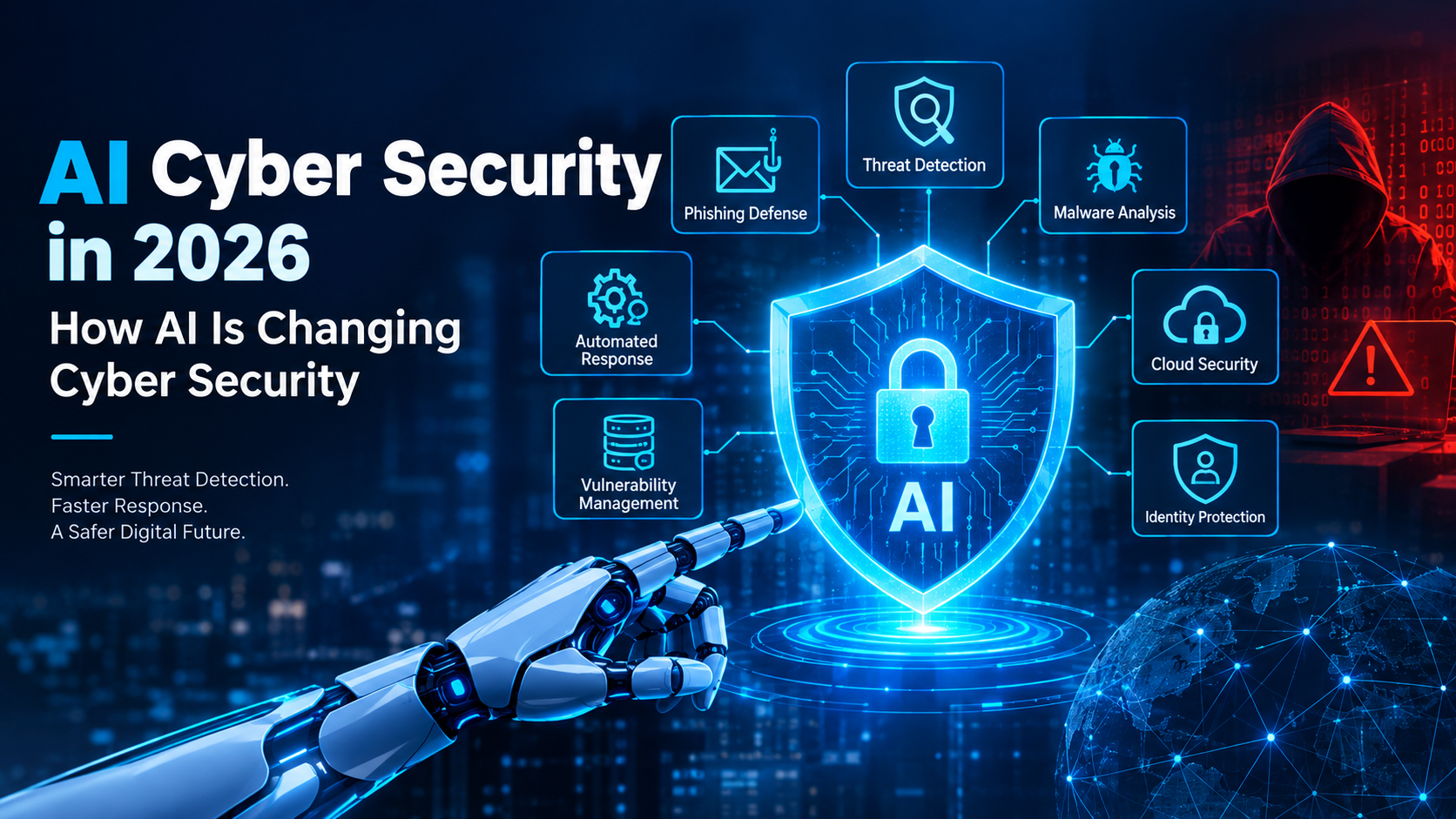
Cybersecurity has always been a race between attackers and defenders. As technology evolves, both sides gain access to more powerful tools. In 2026, artificial intelligence has become one of the most important technologies influencing that race.
From analyzing enormous amounts of security data to identifying suspicious behavior in seconds, AI is changing how organizations detect, investigate, and respond to cyber threats.
At the same time, cybercriminals are also using AI to improve phishing campaigns, automate reconnaissance, generate convincing social engineering messages, accelerate malware development, and scale attacks.
This creates a new cybersecurity landscape where artificial intelligence is not simply another security tool. It is becoming part of the infrastructure used to defend digital systems and, increasingly, part of the infrastructure used to attack them.
In this guide, we will explore AI cyber security in 2026, how artificial intelligence is changing cybersecurity operations, the benefits and risks of AI-powered security, how attackers are using AI, and what organizations can do to prepare for the next generation of cyber threats.
What Is AI Cyber Security?
AI cyber security refers to the use of artificial intelligence and machine learning technologies to protect computers, networks, applications, identities, cloud environments, and data from cyber threats.
Traditional cybersecurity often relies heavily on predefined rules and signatures.
For example, a security system might recognize a known malicious file because its signature matches a previously identified threat.
AI can approach security from another direction.
Instead of only asking:
"Have we seen this threat before?"
AI-powered systems can also ask:
"Does this behavior look suspicious?"
This distinction is important because attackers constantly modify their techniques.
AI can analyze patterns across large datasets and identify unusual activity that might otherwise be difficult for human analysts to spot.
Why Is AI Important for Cybersecurity in 2026?
Modern organizations generate enormous amounts of security data.
A typical enterprise can produce information from:
- Firewalls
- Servers
- Cloud platforms
- Endpoints
- Applications
- Identity systems
- Email gateways
- Network devices
- Authentication systems
- Security tools
- SaaS applications
- Mobile devices
Human security teams cannot manually examine every event.
This is where AI becomes valuable.
AI systems can process large quantities of information quickly, prioritize suspicious events, identify relationships between seemingly unrelated alerts, and help analysts investigate incidents.
The result can be a security operation that is faster, more scalable, and better able to handle large volumes of information.
AI-Powered Threat Detection
One of the most important applications of AI in cybersecurity is threat detection.
Traditional security systems may depend heavily on known signatures, rules, and indicators of compromise.
AI can complement these approaches by looking for unusual behavior.
For example, imagine an employee normally logs into a company system from Pakistan during business hours.
Suddenly, the account:
- Logs in from a new country
- Accesses unfamiliar systems
- Downloads a large amount of data
- Creates unusual authentication activity
- Attempts privileged operations
Each individual event might not automatically indicate an attack.
Together, however, they could form a suspicious behavioral pattern.
AI-based security systems can correlate these signals and assign a higher risk level to the activity.
Behavioral Analysis
Behavioral analysis is particularly valuable because attackers do not always behave exactly like known malware.
AI can establish patterns of normal behavior and identify deviations.
Examples include:
- Unusual login locations
- Abnormal data transfers
- Unexpected administrative activity
- Unusual application access
- Suspicious process behavior
- Abnormal network connections
- Rapid account activity
This approach can help security teams discover attacks that traditional signature-based detection might miss.
However, behavioral systems can also produce false positives.
A legitimate employee traveling to another country may suddenly appear suspicious.
This is why AI should support human judgment rather than automatically assume every anomaly is malicious.
AI in Security Operations Centers
Security Operations Centers, commonly called SOCs, receive enormous numbers of security alerts.
One of the biggest challenges for security teams is alert fatigue.
If analysts receive thousands of alerts, it becomes difficult to determine which ones deserve immediate attention.
AI can help prioritize alerts.
Instead of presenting every event equally, an AI-assisted security system can consider factors such as:
- Asset importance
- User identity
- Historical behavior
- Threat intelligence
- Event severity
- Attack patterns
- Previous incidents
- Relationships between events
The system can then help analysts focus on the alerts with the highest potential risk.
This can make SOC operations more efficient.
AI and Automated Incident Response
Detection is only one part of cybersecurity.
Once a threat is discovered, organizations need to respond.
AI can assist with incident response by helping security teams:
- Identify affected systems.
- Investigate suspicious activity.
- Correlate related events.
- Determine potential attack paths.
- Recommend containment actions.
- Collect relevant evidence.
- Generate incident summaries.
Some security platforms can also automate specific response actions.
For example, a system may isolate a compromised endpoint or disable a suspicious account based on predefined policies.
Fully autonomous response should be used carefully because incorrect decisions can disrupt legitimate business operations.
AI for Phishing Detection
Phishing remains one of the most common cybersecurity threats.
Traditional email security systems can identify suspicious domains, attachments, links, and known malicious patterns.
AI can analyze additional characteristics such as:
- Writing style
- Context
- Sender behavior
- Message structure
- Link patterns
- Conversation history
- Unusual requests
- Impersonation indicators
This can help identify sophisticated phishing attempts.
However, AI has also made phishing more dangerous.
Attackers can use generative AI to create convincing messages with better grammar and more personalized language.
This means organizations cannot rely on obvious spelling mistakes as a primary phishing indicator.
Generative AI and Social Engineering
Generative AI has changed the economics of social engineering.
Attackers can potentially generate large numbers of customized messages much faster than before.
For example, an attacker might use publicly available information about an organization to create highly targeted communication.
Potential targets include:
- Employees
- Executives
- Customers
- Vendors
- Finance teams
- IT administrators
AI-generated messages can be customized according to a target's role, interests, language, and communication style.
This makes security awareness increasingly important.
Employees need to learn how to verify unusual requests rather than simply looking for poor grammar.
AI-Powered Malware
Artificial intelligence is also influencing malware development.
Attackers can use AI-assisted programming tools to help generate, modify, or analyze code.
The important point is not that AI automatically creates unstoppable malware.
Cybercriminals still face significant technical barriers.
However, AI can lower the amount of time required to perform certain tasks.
AI can potentially assist attackers with:
- Code analysis
- Script generation
- Obfuscation
- Reconnaissance
- Vulnerability research
- Automation
- Social engineering
This can increase the speed and scale of attacks.
AI for Malware Analysis
The defensive side of this development is equally important.
Security researchers can use machine learning and AI-assisted analysis to examine suspicious files and code.
AI can help identify:
- Similar malware families
- Suspicious behaviors
- Unusual code patterns
- Indicators of compromise
- Potential attack techniques
This can accelerate malware analysis and help security teams understand new threats more quickly.
AI and Vulnerability Management
Modern organizations may have thousands of applications, dependencies, devices, containers, APIs, and cloud resources.
Keeping everything patched is difficult.
AI can help prioritize vulnerabilities based on factors such as:
- Severity
- Exploitability
- Asset importance
- Exposure to the internet
- Available exploits
- Business impact
- Existing security controls
Instead of treating every vulnerability equally, organizations can focus resources on vulnerabilities that represent the greatest practical risk.
This is particularly valuable for large environments.
AI in Cloud Security
Cloud environments are highly dynamic.
Resources can be created and removed quickly, identities may have complex permissions, and applications can communicate across multiple services.
AI can help monitor cloud environments for suspicious behavior.
Potential applications include:
- Detecting unusual cloud activity
- Identifying excessive permissions
- Monitoring identity behavior
- Detecting suspicious API calls
- Finding configuration anomalies
- Identifying unusual data access
AI can therefore complement cloud security posture management and identity security tools.
AI and Identity Security
Identity has become a central component of cybersecurity.
Organizations increasingly use:
- Passwordless authentication
- Multi-factor authentication
- Single sign-on
- Privileged access management
- Conditional access
- Behavioral authentication
AI can analyze identity behavior to identify unusual activity.
For example, an account that normally accesses five applications suddenly attempts to access dozens of sensitive systems.
That behavioral change may deserve investigation.
AI can help connect these signals and create a more detailed risk picture.
AI for Network Security
Networks generate massive amounts of telemetry.
AI can analyze network traffic to identify unusual patterns.
Potential indicators include:
- Unexpected connections
- Abnormal traffic volumes
- Unusual protocols
- Suspicious destinations
- Lateral movement
- Command-and-control patterns
AI-based network detection can be particularly useful when attackers attempt to move through an environment after gaining initial access.
AI and Zero-Day Threats
A zero-day vulnerability is a security flaw that defenders may have little or no prior warning about.
Traditional signature-based detection can struggle when there is no known signature.
AI-based behavioral analysis can provide another layer of defense.
Instead of looking only for the exact vulnerability, security systems can monitor for suspicious behavior associated with exploitation.
For example:
- Unexpected process execution
- Privilege escalation
- Unusual memory activity
- Suspicious network connections
- Abnormal file changes
AI does not magically solve zero-day vulnerabilities, but behavioral detection can help organizations respond to previously unknown attack patterns.
AI for Security Code Review
Software vulnerabilities are often introduced during development.
AI-assisted development and code analysis tools can help developers identify potentially risky patterns.
AI can assist with:
- Code review
- Dependency analysis
- Security recommendations
- Vulnerability identification
- Secure coding suggestions
- Static analysis
However, developers should verify AI-generated recommendations.
AI systems can make incorrect assumptions, misunderstand application context, or miss vulnerabilities.
Human review remains essential.
AI and API Security
APIs are critical components of modern applications.
They connect:
- Mobile applications
- Websites
- SaaS platforms
- Microservices
- Payment systems
- Internal services
Attackers may target APIs through authentication abuse, excessive requests, data exposure, and other techniques.
AI can help identify unusual API behavior.
For example:
Normal:
User → API → 20 requests

Suspicious:
User → API → 20,000 requests
The difference may indicate automation, abuse, credential
compromise, or another security issue.
AI can help detect such patterns faster.
AI and Deepfakes
One of the emerging challenges in cybersecurity is synthetic media.
AI can generate increasingly convincing:
- Images
- Audio
- Video
- Text
Attackers may use these technologies for impersonation and fraud.
Imagine receiving a video call that appears to come from a company executive asking an employee to transfer money.
The employee can no longer rely entirely on visual or audio recognition.
Organizations therefore need stronger identity verification procedures.
For sensitive transactions, verification should rely on trusted processes rather than appearance or voice alone.
AI-Powered Fraud Detection
Financial systems already rely heavily on automated detection.
AI can analyze transaction behavior to identify unusual activity.
Signals can include:
- Transaction amount
- Location
- Device
- Timing
- Account history
- Transaction frequency
- Behavioral patterns
An unusual combination of these signals may trigger additional verification.
This can help organizations detect fraudulent activity while reducing unnecessary friction for legitimate users.
The Dark Side of AI Cyber Security
AI is not automatically beneficial.
The same technologies that help defenders can also help attackers.
This creates a cybersecurity arms race.
Defenders can use AI to:
- Detect threats
- Analyze malware
- Prioritize vulnerabilities
- Automate response
Attackers can use AI to:
- Improve phishing
- Automate reconnaissance
- Generate malicious code
- Scale social engineering
- Analyze targets
- Produce convincing impersonation content
The outcome depends on how responsibly the technology is developed and deployed.
AI Hallucinations and Security Risks
One major challenge with generative AI systems is that they can produce incorrect information.
This is sometimes called hallucination.
In cybersecurity, incorrect information can have serious consequences.
For example, an AI system might:
- Misclassify an alert
- Recommend an incorrect remediation
- Invent a vulnerability
- Misinterpret log data
- Provide an inaccurate incident summary
Security teams should therefore validate important AI-generated conclusions.
AI should be treated as an assistant, not an infallible security oracle.
Data Privacy and AI Security
AI systems may require access to large amounts of information.
This creates another important question:
What data is being sent to the AI system?
Security organizations must carefully consider:
- Customer data
- Personal information
- Credentials
- Source code
- Internal documents
- Security logs
- Incident information
Sensitive information should not be casually submitted to external AI services.
Organizations need appropriate data governance, access controls, retention policies, and privacy protections.
Prompt Injection and AI Security
As organizations integrate AI into applications, attackers can target the AI systems themselves.
One example is prompt injection.
An attacker may attempt to manipulate an AI system by providing malicious instructions through input data.
This becomes especially important when AI systems can:
- Access databases
- Browse websites
- Read documents
- Execute actions
- Call APIs
- Modify systems
An AI agent with excessive permissions can become a significant security risk.
The principle of least privilege therefore remains important for AI systems.
AI Supply Chain Security
Modern software depends on complicated supply chains.
Applications may use:
- Open-source libraries
- APIs
- Cloud services
- AI models
- Plugins
- Development tools
AI adds another layer to this ecosystem.
Organizations need to understand where AI models and services originate, what data they use, how they are updated, and what dependencies they contain.
AI security should therefore become part of broader software supply chain security.
Human Expertise Still Matters
It may be tempting to believe that AI will replace cybersecurity professionals.
That is unlikely to be the complete story.
Cybersecurity involves:
- Business decisions
- Risk management
- Context
- Ethics
- Investigation
- Communication
- Strategic planning
AI can process information quickly, but humans remain responsible for understanding business consequences and making high-impact decisions.
The strongest security teams are likely to combine:
Human expertise + automation + AI-assisted analysis
rather than relying entirely on autonomous systems.
How Businesses Can Prepare for AI-Driven Cyber Threats
Organizations should take several practical steps.
1. Strengthen Identity Security
Use strong authentication and protect privileged accounts.
2. Implement Multi-Factor Authentication
MFA can reduce the impact of stolen credentials.
3. Train Employees
Security awareness should include modern AI-powered phishing and impersonation techniques.
4. Maintain Asset Visibility
Organizations cannot secure systems they do not know exist.
5. Patch Critical Vulnerabilities
Prioritize vulnerabilities based on actual risk and exposure.
6. Monitor Unusual Behavior
Behavioral monitoring can identify suspicious activity that signature-based systems may miss.
7. Protect AI Systems
AI applications need authentication, authorization, logging, input validation, and secure integration.
8. Establish AI Governance
Organizations should define acceptable uses of AI and establish policies for sensitive information.
9. Test AI Security
AI-powered applications should be tested for manipulation, data leakage, prompt injection, excessive permissions, and other risks.
The Future of AI Cyber Security
The relationship between artificial intelligence and cybersecurity will likely become even deeper.
Future security systems may increasingly combine:
- AI agents
- Automated threat hunting
- Behavioral analytics
- Real-time detection
- Continuous identity analysis
- Automated vulnerability prioritization
- AI-assisted incident response
- Security copilots
- Predictive risk analysis
Security teams may spend less time manually searching through raw alerts and more time investigating high-value threats and making strategic decisions.
At the same time, attackers will continue adapting.
This means cybersecurity will not become a problem that AI simply "solves."
Instead, AI will become another layer in the ongoing security battle.
AI Cyber Security Best Practices for 2026
Organizations adopting AI for security should follow several principles.
Use AI as a Force Multiplier
AI should increase the capabilities of security teams rather than eliminate necessary human oversight.
Keep Humans in the Loop
High-impact decisions should have appropriate human review.
Apply Least Privilege
AI systems should only have access to the information and systems they actually need.
Protect Sensitive Data
Do not expose confidential information to AI systems without appropriate security controls.
Monitor AI Activity
AI systems should be logged and monitored just like other critical applications.
Validate AI Output
Important security decisions should not depend blindly on AI-generated conclusions.
Test Continuously
Threats evolve, so AI security systems should be evaluated and updated continuously.
Frequently Asked Questions
What is AI cyber security?
AI cyber security is the use of artificial intelligence and machine learning to detect, prevent, investigate, and respond to cybersecurity threats.
How is AI changing cybersecurity in 2026?
AI is helping security teams analyze large volumes of data, detect unusual behavior, prioritize alerts, investigate incidents, identify vulnerabilities, and automate selected security tasks.
Can AI replace cybersecurity professionals?
AI can automate many repetitive tasks, but cybersecurity still requires human expertise, judgment, context, and strategic decision-making.
Can hackers use AI?
Yes. Attackers can use AI to assist with phishing, social engineering, reconnaissance, coding, automation, and other activities. This creates an ongoing AI-powered cybersecurity arms race.
Does AI make cybersecurity more secure?
AI can improve detection and response capabilities, but it also introduces new risks. The security benefit depends on how AI is implemented, monitored, and governed.
How does AI detect cyber threats?
AI can analyze behavioral patterns, network activity, identity events, files, logs, and other signals to identify anomalies or suspicious activity.
What are the risks of AI in cybersecurity?
Risks include false positives, incorrect AI recommendations, data privacy issues, prompt injection, excessive AI permissions, model manipulation, and the use of AI by attackers.
How can businesses protect themselves from AI-powered attacks?
Businesses should strengthen identity security, use MFA, train employees, patch vulnerabilities, monitor unusual activity, protect sensitive data, and establish clear AI governance.
Conclusion
AI cyber security is becoming one of the defining areas of cybersecurity in 2026.
Artificial intelligence is changing how organizations detect threats, analyze security events, investigate incidents, prioritize vulnerabilities, protect identities, monitor networks, and respond to attacks.
But the story has another side.
Attackers are also using AI to improve social engineering, automate certain tasks, create more convincing phishing campaigns, and increase the scale of their operations.
This means the future of cybersecurity will not simply be humans versus hackers.
It will increasingly involve AI-assisted defenders versus AI-assisted attackers.
Organizations that treat AI as a strategic security capability can potentially gain significant advantages. However, successful implementation requires more than purchasing an AI-powered security product.
Businesses need strong identity controls, secure infrastructure, employee awareness, data protection, human oversight, AI governance, and continuous testing.
The most effective approach is therefore not to hand cybersecurity entirely to artificial intelligence.
It is to combine the speed and analytical capabilities of AI with the judgment and experience of skilled security professionals.
As digital systems continue to grow more complex, that combination will become increasingly important.
For developers, businesses, and technology professionals, understanding AI cyber security is no longer simply an emerging topic. It is becoming an essential part of understanding how modern digital systems are protected.